Why I Got A Salesforce Administrator Certification
Post Statistics
This post has 514 words.
This post has 3639 characters.
This post will take about 2 minute(s) to read.
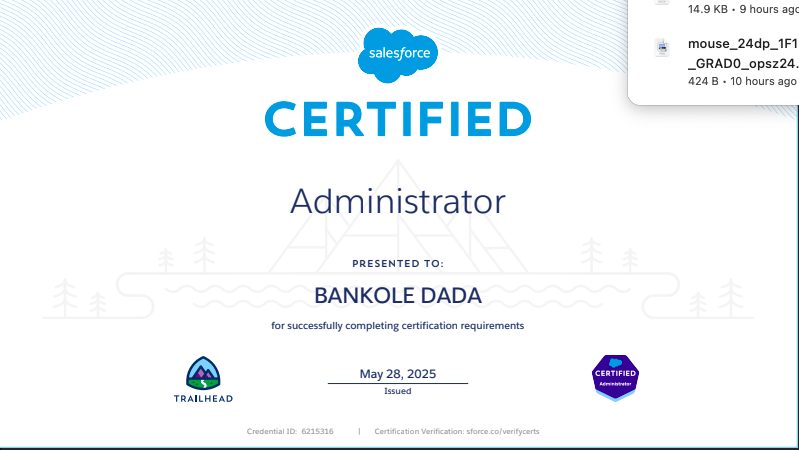
As an experienced business analyst with a product mindset, over the years i have worked with salesforce to help deliver business outcomes and objectives. Recently it just felt right to get a salesforce administrator certification to boost my knowledge and help get my foot better in the door.
Salesforce is a cloud-based software company that has revolutionized the way businesses interact with customers, manage sales pipelines, and streamline marketing and customer service. Whether you’re a small startup or a global enterprise, Salesforce offers tools that can scale with your business and boost your productivity. My experience working with salesforce puts it as a big massive solutions, often complicated, that can deliver great outcomes for teams with the right mindset.
What is Salesforce?
Salesforce is best known for its Customer Relationship Management (CRM) platform. A CRM is a system that helps businesses manage interactions with current and potential customers. Unlike traditional CRMs that required on-premise hardware and complicated setups, Salesforce operates entirely in the cloud, which means you can access it from anywhere with an internet connection.
Founded in 1999 by Marc Benioff, Salesforce pioneered the Software-as-a-Service (SaaS) model, allowing businesses to subscribe to software rather than buy and install it. Over the years, it has grown into a powerful platform that covers far more than just sales — it includes tools for marketing automation, analytics, customer service, app development, and even AI-powered insights through Salesforce Einstein.
Key Features of Salesforce
- Sales Cloud – Helps sales teams track leads, opportunities, and customer interactions. It provides real-time dashboards, forecasts, and productivity tools.
- Service Cloud – Aimed at customer support teams, it allows businesses to manage support tickets, automate responses, and offer support via multiple channels including chat, email, and phone.
- Marketing Cloud – Enables marketers to plan and execute campaigns, personalize customer journeys, and analyze performance data.
- Commerce Cloud – Supports both B2B and B2C businesses in creating seamless eCommerce experiences.
- AppExchange – Salesforce’s marketplace for third-party apps and integrations, giving users access to thousands of tools to extend functionality.
- Salesforce Platform – Allows businesses to build custom apps using low-code or no-code tools.
- Einstein AI – Offers AI-powered analytics to predict customer behavior, recommend actions, and automate tasks.
Why Do Businesses Use Salesforce?
One of Salesforce’s greatest strengths is its flexibility. Whether you’re tracking sales leads, managing a marketing campaign, or handling customer support tickets, Salesforce can be customized to match your exact business process. Its cloud-based structure means it’s scalable, secure, and regularly updated with new features.
Moreover, Salesforce integrates with countless other tools like Slack, Gmail, Outlook, and ERP systems, making it a central hub for many business operations.
About The Certification
Salesforce is much more than a CRM, its a massive piece of software that can do a thousand and one thing! Getting the certification took a lot of learning, connecting, doing and becoming.
I took the following step to get ready
- Volunteered to get more hands on experience
- Set up an event project in salesforce, creating custom objects and more
- Got specialised training and access to a sandbox environment
- Practiced questions and repeated
